AAR Restoration Holmdel Township
📞 848-337-3687
Property Damage Restoration Elizabeth, NJ
24/7 Emergency Response

Storm Damage Restoration in Holmdel Township.

Active storm damage in Holmdel Township? Crew dispatched with tarps, plywood, and extraction gear before the next band hits.

📞 848-337-3687 Local team in Holmdel Township 24/7 dispatch
Sub-Hour Average on-site response time
Pre-Staged Equipment ready for surge events
Multi-Unit COIs on file at major buildings
Service Overview

How We Approach It

After the storm passes, the priority order is: secure the envelope (board-up + tarping), extract any water that entered, document everything for insurance, then start the reconstruction conversation. We dispatch with all four capabilities so a single crew handles the loss end-to-end.

What's Included

  • Emergency board-up + tarping
  • Wind-driven rain water extraction
  • Roof + envelope repair
  • Tree impact damage
  • Insurance documentation
  • Full structural rebuild

What to Do in the First Hour After Storm Damage

The actions that matter in the first hour: secure the property if safe to do so, document the damage with photos, file the insurance claim, and call a restoration crew that can dispatch immediately. The actions that hurt the claim: signing AOB paperwork from a storm-chase contractor, throwing damaged contents away before documentation, attempting permanent repairs before the carrier has had a chance to inspect, or letting the property sit exposed because "the contractor will be here tomorrow."

For roof openings, get a tarp up if it is safe. For broken windows, board the opening to prevent further weather + animal intrusion. For interior water from a roof leak, place buckets under active drips and move what you can save away from the path of travel. Don't try to lift wet sheetrock yourself — it crumbles and makes the cleanup worse.

Photograph the loss in its current state — wide shots, close-ups, anything visible from the source of intrusion to the damaged contents. Before-photos are the foundation of the insurance scope. Without them, the adjuster has no basis to evaluate what was there before the loss.

Common NJ Storm Patterns We Handle

Tropical storms (Aug-Nov): wind damage to roofs and siding, wind-driven rain through compromised envelopes, occasional surge flooding in shore communities. Hurricane remnants tracking up the coast generate the bulk of our late-summer call volume.

Nor'easters (Oct-Apr): sustained heavy rain over multiple days creates roof leaks at flashing transitions, ice damming on cold-weather events, and wind damage similar to tropical storms. The NJ shore takes the worst of nor'easter activity but inland counties also see significant water intrusion.

Ice storms: tree impact damage from ice loading on branches, ice damming where roof eaves are inadequately insulated, and burst pipes in unheated spaces (garages, attics, crawlspaces, vacant properties). The frozen-pipe-burst calls dominate the post-ice-storm response window.

Summer thunderstorms: straight-line winds (similar damage profile to tornadoes), hail damage to roofs and siding, lightning strikes that cause electrical fires, and flash flooding when sustained rainfall exceeds storm-drain capacity in older neighborhoods.

Process

Our Process

  1. 01

    Initial Inspection

    Moisture mapping with calibrated meters. Photo documentation. Cause-of-loss narrative. Loss category assignment per IICRC S500.

  2. 02

    Source Control + Containment

    Confirm water source is fully off. Isolate affected area with plastic sheeting + negative air pressure. Contaminated materials removed to documented flood line.

  3. 03

    Structural Drying

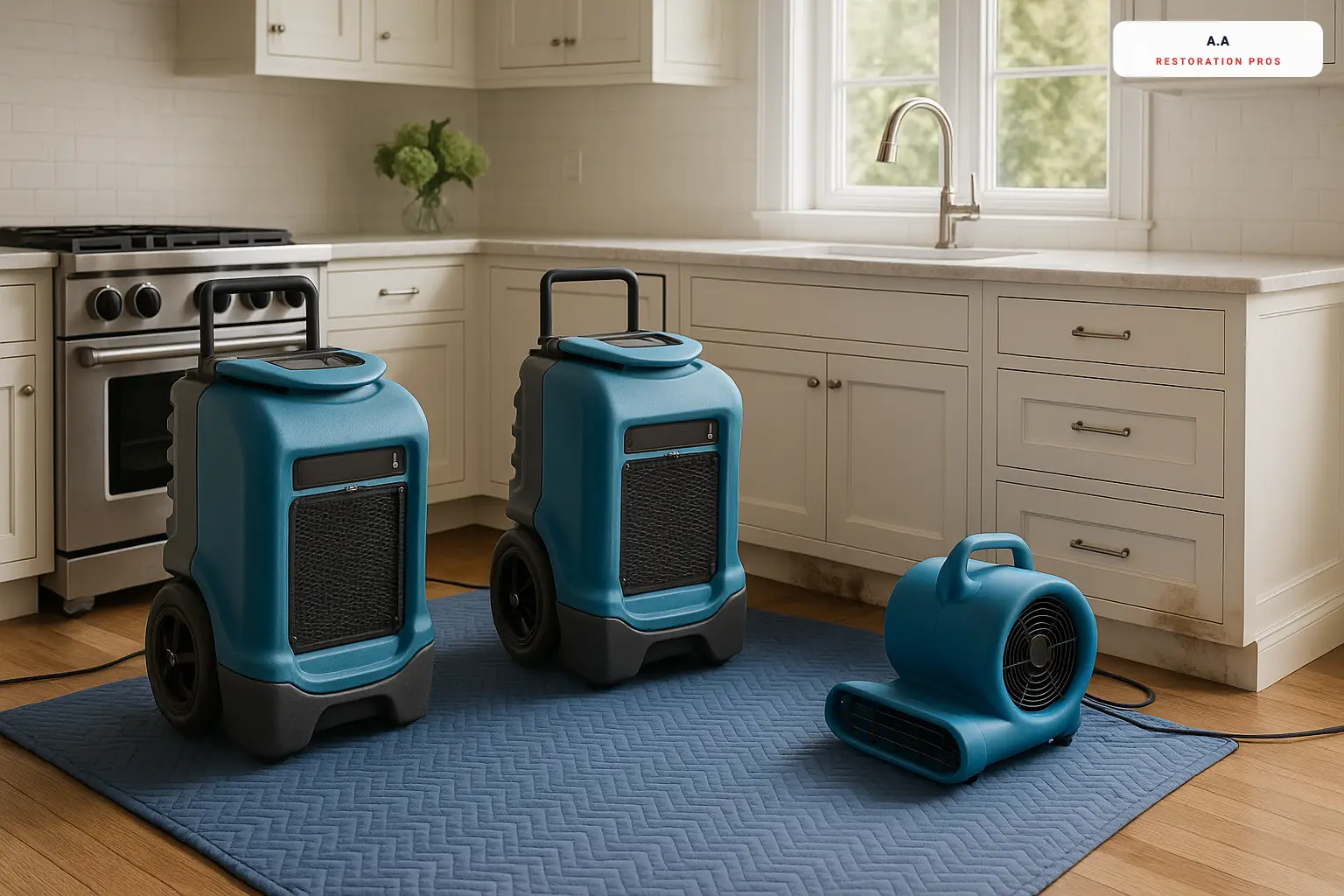
    Air mover placement calculated for affected square footage. LGR dehumidifier capacity matched to interior volume. Continuous monitoring until moisture content returns to baseline.

  4. 04

    Mold Prevention

    EPA-registered antimicrobial applied to substrate that contacted contaminated water. HVAC system inspection if water entered the air handling system. Final clearance confirms no microbial activity.

  5. 05

    Reconstruction to Pre-loss Condition

    Materials matched to pre-loss specification. Workmanship guarantee documented in the contract. Walkthrough with written punch list before final invoice.

24/7 Emergency

24/7 emergency response across Monmouth County. Real human, real truck, real fast.

We dispatch a tech 24/7 across the Holmdel Township metro. Average on-site time is under an hour.

Call 848-337-3687
The difference

Why Customers Choose Us

Real reasons. No invented stats, no manufactured awards.

  • 01

    Real Holmdel Township Dispatch

    Phone answered by a human in NJ 24/7. No automated phone tree, no offshore call-center, no callback after the loss has gotten worse. Truck rolls while you are still on the call.

  • 02

    Insurance Documentation Discipline

    Photos, moisture readings on a building diagram, Xactimate scope at carrier-standard pricing, equipment runtime logs. The full record goes to the adjuster so the claim closes without back-and-forth.

  • 03

    Single-Source Contracting

    Same crew handles mitigation AND reconstruction. No handoff to a separate general contractor mid-job. One contract, one phone number, one team accountable from first call to final walkthrough.

Service Area

Serving Monmouth County

From our Holmdel Township base we cover Monmouth County and the immediately surrounding NJ municipalities. Sub-hour response on active losses, pre-staged equipment for storm season, IICRC-standard methodology applied to every job regardless of size.

Counties Covered

  • Monmouth County, NJ

Cities We Service

Each Monmouth city below opens a local page with arrival times from our Holmdel Township base and the loss patterns we handle most often in that municipality.

Not sure if you're in our area? Call 848-337-3687 and we'll tell you in 30 seconds.
FAQ

Frequently Asked Questions

If you don't see your question, just call or message us.

Can I clean up the water myself before you arrive? +

You can extract surface water with a wet/dry vacuum and start moving content away from the cascade path — those help. Do not lift wet drywall (it crumbles and makes cleanup harder), do not run heaters trying to dry it yourself (you drive moisture deeper into materials), and do not throw damaged contents away before we document for insurance. The 30-60 minutes between your call and our arrival are worth using for documentation, not partial demo.

What is the difference between mitigation and reconstruction? +

Mitigation is the emergency phase — stopping the loss, extracting water, drying the structure, removing damaged material. Reconstruction is the rebuild — replacing drywall, installing flooring, painting, finishing. Many restorers only do mitigation and hand the rebuild to a separate general contractor, which often creates scope-coordination problems. We do both as one contract so the rebuild matches what was scoped during mitigation.

Do you handle storm damage to roofs? +

Emergency tarping yes — we secure compromised roof openings to prevent further weather intrusion. Permanent roof replacement we coordinate with a licensed roofing contractor in our network rather than doing in-house. The water damage that follows roof intrusion is our scope; the structural roof itself is a roofer's scope. We handle the coordination so you have one project manager not two.

How do you document moisture readings for insurance? +

We map every wet substrate on a building diagram, take initial moisture readings with calibrated meters, log readings at every daily monitoring visit, and compare against the manufacturer's dry-standard for that material. Final clearance readings show every wet substrate returned to baseline. Adjusters get the full record — building diagram, meter readings by date, equipment run logs. This is what gets the claim approved without back-and-forth.

What happens if mold is found during the dry-out? +

If we discover existing mold growth during a water restoration job — which happens when a slow leak was already growing mold before the recent loss — we contain that area immediately and remediate per IICRC S520 before reconstruction starts. The discovery becomes a supplemental scope item for the carrier. Done correctly, both the water loss and the pre-existing mold get resolved as one coordinated project.

Do you offer free estimates? +

For property losses (water, fire, storm, sewage), we provide a no-cost on-site assessment and an Xactimate scope of work. For non-emergency reconstruction or mold remediation we provide a written estimate after on-site evaluation. We do not give phone-quote prices for restoration work — accurate scoping requires seeing the loss in person.

What certifications do your technicians hold? +

Our crew holds IICRC certifications in Water Damage Restoration (WRT), Applied Structural Drying (ASD), and Applied Microbial Remediation (AMRT) per IICRC S500/S520 standards. Specific cert status of any technician on your job is available on request — we do not stretch certifications we do not actually hold.

Call Now • Holmdel Township

Active Loss in Holmdel Township? We Handle Mitigation Through Reconstruction.

One phone call gets a truck rolling. Real Holmdel Township team, real local response time, no automated phone tree. We'll be on site fast.

📞 Tap To Call 848-337-3687

24/7 Emergency Dispatch

📞 Call 848-337-3687